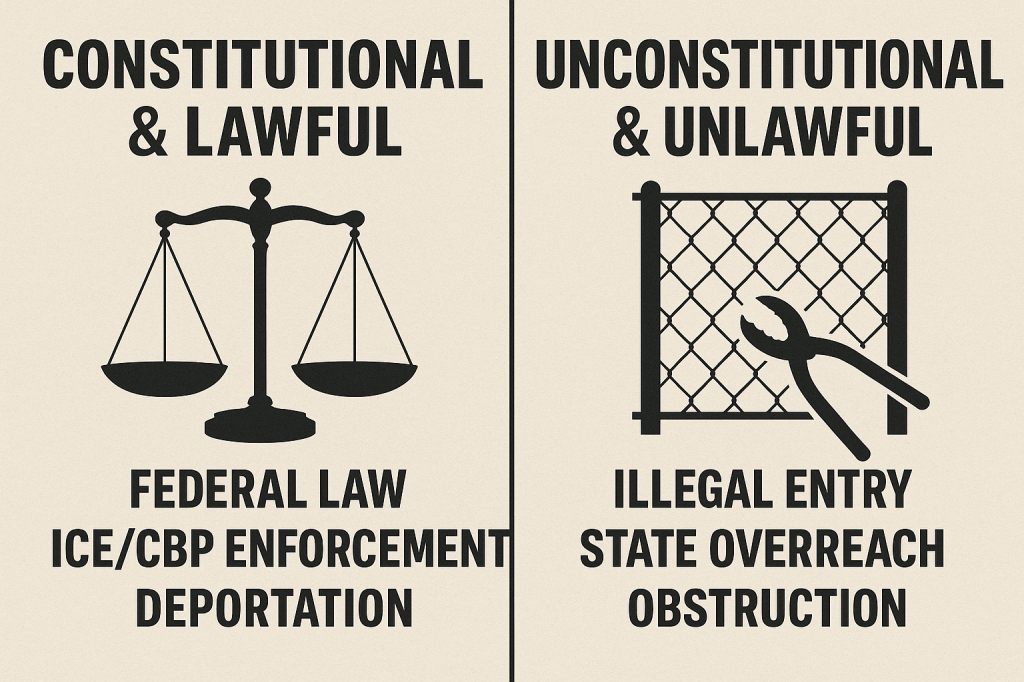
The Rule of Law, Not a Matter of Opinion
Illegal immigration is often presented in modern debate as if it were an ambiguous matter of policy, one that depends on political preference or public sympathy. But in reality, it is not ambiguous at all. It is a straightforward question of law. In the United States, immigration is governed by a body of federal statutes enacted through the democratic process, signed into law by the President, and interpreted by the courts. That body of law is clear in its requirements and its prohibitions. When someone is present in the United States outside of those rules, their status is not subject to opinion or interpretation. They are here illegally.
This is not simply a matter of semantics or legal technicality. The United States is a nation built on the principle of the rule of law — the idea that laws apply equally to all and that no person is above them. When immigration law is ignored, the damage is not limited to border control or population statistics. It is an assault on that principle itself. If some laws can be disregarded because they are inconvenient or politically unpopular, then the foundation of equal justice under the law begins to erode. Immigration becomes the testing ground for whether America is truly a republic governed by laws or a country governed by arbitrary decisions.
The law is not silent on how immigration should work. The Immigration and Nationality Act (INA), first enacted in 1952 and amended many times since, establishes in detail who may enter, under what circumstances, for how long, and with what status. It specifies how visas are issued, how asylum may be claimed, and under what conditions individuals may be removed. It also defines penalties for those who enter without authorization or who fail to depart when required. There is no ambiguity in the text. These rules were debated and passed in Congress, signed by Presidents of both parties, and remain the controlling law of the land.
To call someone an “illegal alien” is therefore not an act of cruelty but an act of accuracy. It describes exactly what the law recognizes: a person who is not a U.S. citizen or national and who is present in the country in violation of immigration statutes. Attempts to rename this status with softer terms — “undocumented,” “unauthorized,” “irregular” — are political maneuvers designed to obscure reality. They do not appear in the law, and they do not change the fact that illegal presence is unlawful presence. Nor is enforcing these laws “unconstitutional,” as critics often claim; the Constitution grants Congress the authority to regulate immigration, and the courts have repeatedly upheld the enforcement powers of federal agencies like DHS and ICE.
The importance of starting from this foundation cannot be overstated. Illegal immigration is not about compassion, opportunity, or whether someone is a “good person.” Those are distractions from the core truth: there are laws in place, and those laws establish clear requirements for lawful entry and stay. Every citizen is expected to obey the law, and immigrants who follow the proper process are bound by the same expectation. To excuse those who break the law is to create a double standard that punishes the law-abiding while rewarding those who circumvent the rules. That is not justice. That is corruption of the rule of law.
How Immigration Law Is Made
Immigration law in the United States is not arbitrary, nor is it created by unelected officials issuing guidance memos. It is the product of the same constitutional process that governs every other federal law. Article I, Section 8 of the Constitution grants Congress the authority “to establish a uniform rule of naturalization.” This clause makes immigration policy a federal responsibility, not something left to the states or to administrative agencies acting on their own. That distinction is crucial: immigration law is not simply federal by tradition — it is federal by constitutional design. States may not create their own competing immigration systems, and the Executive Branch cannot unilaterally replace Congress’s role by rewriting statutes.
The central statute is the Immigration and Nationality Act (INA) of 1952. This law consolidated decades of prior immigration statutes into one comprehensive framework. Before the INA, immigration policy had been governed by a patchwork of laws, such as the Chinese Exclusion Act of 1882 and the Immigration Act of 1924, which used a national origins quota system to heavily restrict immigration from certain parts of the world. By codifying and organizing these provisions, the INA gave the United States a unified body of law governing who could enter, how long they could stay, the grounds for exclusion or deportation, and the process for naturalization.
Over time, Congress has repeatedly amended the INA to respond to changing circumstances. The 1965 Hart-Celler Act abolished the discriminatory quota system and replaced it with a preference system prioritizing family reunification and skilled workers. The 1980 Refugee Act established procedures for admitting refugees and created the asylum process, aligning U.S. practice with international obligations. The 1986 Immigration Reform and Control Act (IRCA) legalized nearly three million aliens who had entered illegally before 1982 but, in exchange, created penalties for employers who knowingly hired illegal aliens. The 1996 Illegal Immigration Reform and Immigrant Responsibility Act (IIRIRA) tightened enforcement, created expedited removal procedures, and expanded the categories of deportable offenses. Each of these laws was debated, passed in both chambers, and signed into law by the President.
An important distinction must be made here. The President does have significant constitutional authority in matters of foreign affairs and national security, which often intersect with immigration. For example, under 8 U.S.C. § 1182(f), Congress explicitly authorized the President to suspend entry of aliens when he determines that their entry would be detrimental to the national interest. This power has been upheld by the Supreme Court, most recently in Trump v. Hawaii (2018), which affirmed that the President may temporarily restrict entry from certain countries for national security reasons. What the President cannot do, however, is nullify or rewrite Congress’s statutory framework through executive order. The Constitution vests the power to create immigration law in Congress, and the President’s role is to enforce it faithfully, with limited discretion only where Congress has granted it.
This distinction also explains where real unconstitutional acts occur. It is not unconstitutional for ICE or CBP to enforce federal immigration statutes — those powers were explicitly granted by Congress and affirmed by the courts. What is unconstitutional are attempts by states, cities, or even federal officials to obstruct or usurp Congress’s authority. Sanctuary laws that prohibit cooperation with federal enforcement, state efforts to grant de facto legal status, or executive actions that openly defy statutory mandates are intrusions on a power reserved exclusively to the federal government. They are unconstitutional not because enforcement is wrong, but because they undermine the constitutional allocation of power to Congress.
This constitutional process matters because it ensures that immigration law is not subject to the whims of individual politicians or unelected bureaucrats. When a law is enacted, it carries the full force of the Constitution behind it. The people, through their elected representatives, have spoken. To ignore those laws or selectively enforce them is to bypass the very process by which they were created. Immigration enforcement, properly understood, is not arbitrary executive action — it is the faithful execution of laws made through the democratic process.
Who Enforces the Law
Passing a law is meaningless without enforcement. The Constitution gives Congress the power to legislate and the President the duty to “take care that the laws be faithfully executed.” Immigration law is no exception. For statutes like the Immigration and Nationality Act to function, there must be agencies with the authority and resources to carry them out. That responsibility lies with the Executive Branch, primarily through the Department of Homeland Security (DHS) and, in certain judicial contexts, the Department of Justice (DOJ). Understanding who enforces immigration law is critical because it debunks the claim that enforcement is arbitrary or unconstitutional. The system is designed to ensure both authority and accountability.
The Department of Homeland Security was created in 2002 in response to the September 11 terrorist attacks. Before then, immigration enforcement functions were housed in the Department of Justice under the Immigration and Naturalization Service (INS). But Congress recognized that border control, immigration enforcement, and counterterrorism were deeply interconnected, and so it reorganized agencies under DHS to create clearer chains of command and tighter coordination. The Homeland Security Act of 2002 transferred these responsibilities to DHS, where they were divided among specialized agencies: Customs and Border Protection (CBP), Immigration and Customs Enforcement (ICE), and U.S. Citizenship and Immigration Services (USCIS). Together, these agencies now carry out the immigration mission that was once scattered across multiple departments.
Customs and Border Protection (CBP) is the frontline agency responsible for securing America’s borders and ports of entry. Its mission is to prevent unlawful entry, intercept contraband, and regulate the flow of people and goods across the border. CBP officers stationed at airports and land crossings determine admissibility under 8 U.S.C. § 1225, while Border Patrol agents patrol between ports of entry to prevent illegal crossings. Their powers are defined by statute, including 8 U.S.C. § 1357, which authorizes questioning, detention, and arrest of individuals suspected of unlawful presence. CBP is therefore the first barrier against illegal entry and the primary enforcer of immigration law at the border.
Immigration and Customs Enforcement (ICE) is tasked with enforcing immigration law within the interior of the United States. It has two main divisions. Homeland Security Investigations (HSI) focuses on crimes like human trafficking, visa fraud, smuggling, and transnational criminal networks. Enforcement and Removal Operations (ERO) is responsible for identifying, detaining, and deporting illegal aliens already inside the country. ICE agents conduct workplace enforcement actions, arrest individuals with outstanding deportation orders, and coordinate with state and local law enforcement. Their authority comes from statutes such as 8 U.S.C. §§ 1226 and 1231, which govern detention and removal, and 8 U.S.C. § 1324, which criminalizes harboring and transporting illegal aliens. Contrary to activist claims, ICE does not act outside constitutional bounds; it operates squarely within the statutory framework created by Congress.
The Department of Justice (DOJ) also plays an essential role in immigration enforcement through the Executive Office for Immigration Review (EOIR). Immigration judges within EOIR preside over removal proceedings under 8 U.S.C. § 1229a. Their job is to ensure due process while applying immigration law as written. They decide whether an alien should be removed, granted relief such as asylum, or otherwise allowed to remain. While critics portray deportation proceedings as lacking fairness, the system provides structured hearings, appellate review through the Board of Immigration Appeals (BIA), and in many cases, judicial oversight by federal courts under 8 U.S.C. § 1252. Far from being lawless, immigration enforcement is tightly regulated by statutes, procedures, and constitutional checks.
Together, DHS and DOJ form a layered enforcement system: CBP intercepts unlawful entry at the borders, ICE enforces immigration law within the interior, and EOIR ensures due process in judicial proceedings. Each of these agencies operates under explicit statutory authority granted by Congress. None of them has the power to unilaterally change the law, and none of them is exercising arbitrary discretion. The claim that immigration enforcement is unconstitutional collapses under this reality: these agencies are not inventing rules, but faithfully executing the laws enacted by the people’s elected representatives. Immigration enforcement, in other words, is not a rogue activity. It is the constitutional fulfillment of the duty to uphold federal law. They are not supposed to add their own criteria such as “unless they’re cute,” “unless they’ve been here long enough,” or “unless they’re unpopular.” Their role is to enforce the law as written — nothing more and nothing less.
Defining “Illegal Alien”
The debate over terminology is not a trivial matter of word choice. It is an intentional effort to shape how the public perceives immigration law. For decades, U.S. law has used the term alien to describe anyone who is not a citizen or national of the United States. This is not a pejorative label — it is a precise legal definition set forth in the Immigration and Nationality Act (INA):
“The term ‘alien’ means any person not a citizen or national of the United States.”
— INA § 101(a)(3), 8 U.S.C. § 1101(a)(3)
This definition is straightforward. It distinguishes citizens and nationals from all others. The law does not rely on vague concepts like “immigrant” or “migrant,” which can blur categories of lawful and unlawful presence. It relies on a neutral, exact term: alien. When an alien is present in the United States in violation of immigration law, they become an illegal alien. That is not an insult, it is a statement of fact.
There are several ways an alien becomes illegal under U.S. law. The first and most visible is entry without inspection — crossing the border unlawfully outside of an official port of entry. This is a crime under 8 U.S.C. § 1325, punishable by fines and imprisonment. A second path is visa overstay. Aliens who lawfully enter the country on a temporary visa but remain beyond its expiration are deemed “unlawfully present” under 8 U.S.C. § 1182(a)(9)(B). Overstays are not rare; they account for a large share of illegal presence in the United States each year. A third route is reentry after removal. An alien who has already been deported but reenters without permission violates 8 U.S.C. § 1231(a)(5), which requires the reinstatement of their prior removal order without further hearing. These provisions make clear that the law is not ambiguous: certain acts place a person outside of lawful status, and those acts are defined with specificity in federal statute.
The courts have consistently affirmed the use of the term illegal alien. In cases like Arizona v. United States (2012), the Supreme Court openly referred to illegal aliens when analyzing federal supremacy in immigration enforcement. Lower courts in criminal prosecutions for illegal entry or illegal reentry routinely use the same terminology. Federal agencies, including DHS and DOJ, continue to use it in official documents. The phrase is embedded in the legal and judicial vocabulary because it is accurate.
Attempts to replace this language with euphemisms such as “undocumented immigrant” or “irregular migrant” are political, not legal. The word undocumented implies that the problem is paperwork, as if the individual simply lost the proper forms. But the issue is not missing documents; it is the violation of immigration law. Similarly, the word immigrant carries the connotation of lawful status, of someone who has been admitted through the proper process. Applying that word to individuals who circumvent the law dilutes its meaning and insults those who follow the rules. These rhetorical substitutions are designed to soften public perception of unlawful acts, but they do not change the reality recognized by Congress and the courts: illegal aliens are here in violation of the law.
Precision in language matters because precision in law matters. A lawful immigrant who has complied with the system — filed applications, passed background checks, been approved by U.S. authorities — is not in the same category as someone who crossed the border unlawfully or overstayed a visa. Blurring these categories by abandoning precise legal terminology undermines the rule of law itself. If everyone is simply an “immigrant,” then the difference between legal and illegal presence vanishes, and so does the meaning of the law. That is why the statutory term illegal alien is correct, necessary, and irreplaceable.
Employment and Benefits Are Prohibited
One of the clearest features of U.S. immigration law is that illegal aliens have no legal right to work in the United States. This principle was written into law with the Immigration Reform and Control Act of 1986 (IRCA). Before IRCA, federal law did not directly penalize employers who hired illegal aliens, which created a powerful incentive for unlawful entry. Congress recognized that as long as there were jobs available, illegal aliens would continue to cross the border, regardless of the risks. To cut off this incentive, IRCA made it unlawful for employers to knowingly hire or employ individuals who are not authorized to work.
The statute, 8 U.S.C. § 1324a, lays out this prohibition in unambiguous terms. Employers are required to verify both the identity and employment authorization of every new hire using the I-9 form. Knowingly hiring an illegal alien can result in civil fines and, in more serious cases, criminal penalties. The law also penalizes the use of false documents and fraudulent claims of work authorization, which are common methods illegal aliens use to obtain employment. Later, the federal government introduced E-Verify, an electronic system that cross-checks employee information against government databases to confirm eligibility. While not mandatory nationwide, many states require its use, and all federal contractors are obligated to comply. The message is clear: there is no lawful path for illegal aliens to participate in the U.S. labor market.
The restrictions on employment are matched by restrictions on public benefits. In 1996, Congress passed the Personal Responsibility and Work Opportunity Reconciliation Act (PRWORA), which drew a firm line between those who were legally present and those who were not. Codified in statutes such as 8 U.S.C. §§ 1611–1613, PRWORA bars illegal aliens from receiving most federal public benefits. This includes programs like Social Security, Medicare, Medicaid, Supplemental Nutrition Assistance Program (SNAP), and housing assistance. The law carved out only narrow exceptions: emergency medical care, disaster relief, immunizations, and certain nutrition programs for children. Beyond these limited categories, illegal aliens are excluded from the social safety net because Congress determined that these programs exist to serve citizens and lawful residents, not those who have broken the law to enter or remain in the country.
Despite these clear prohibitions, many states and municipalities have extended benefits to illegal aliens at their own expense. Some states grant driver’s licenses regardless of immigration status. Others provide in-state tuition rates at public universities, effectively subsidizing higher education for illegal aliens while charging full rates to out-of-state American citizens. A growing number of jurisdictions even provide direct financial assistance, health coverage, or housing aid. These actions are not just misguided policy — they are unconstitutional. The authority to regulate immigration, determine lawful presence, and establish eligibility for public benefits belongs exclusively to the federal government under Article I, Section 8 of the Constitution. When states or localities attempt to carve out exceptions, they are intruding into an area explicitly reserved to Congress. In effect, they are creating shadow immigration policies that directly conflict with federal law and the Constitution itself.
The principle underlying both employment and benefit restrictions is simple: those who are in the country illegally should not be rewarded for breaking the law. Allowing illegal aliens to work legally would collapse the distinction between lawful and unlawful presence, erasing the incentive to follow the rules. Providing benefits undermines the very purpose of a welfare system designed to serve citizens and lawful immigrants. Every dollar spent subsidizing illegal presence is a dollar not spent supporting those who have a rightful claim to assistance. Congress drew bright lines in IRCA and PRWORA, and it did so under explicit constitutional authority. When states and cities ignore those lines, they are not showing compassion. They are undermining the Constitution, defying Congress, and burdening their own citizens in the process.
The Myth of “Paying Their Share”
Advocates of illegal immigration often claim that illegal aliens “pay their share” through taxes and therefore should be tolerated or even welcomed. This argument is designed to make unlawful presence appear harmless or even beneficial. But once the facts are examined, it falls apart. Illegal aliens are excluded from lawful employment by federal statute, and that exclusion has predictable consequences: they do not participate in the tax system in the way citizens and legal residents do. What little they may contribute through certain channels is dwarfed by the cost they impose on public resources.
The first reality is that much illegal employment occurs entirely off the books. Employers who knowingly hire illegal aliens often pay in cash, precisely to avoid scrutiny and liability under 8 U.S.C. § 1324a. Cash wages mean no withholdings for Social Security, Medicare, or federal and state income tax. These are the taxes that fund the very programs advocates claim illegal aliens help support. When illegal aliens work outside the system, not only do they avoid paying into it, but employers also escape their own tax obligations. That is not contribution; that is evasion.
The second reality is that when illegal aliens do work on the books, it often involves fraudulent documents. False Social Security numbers, stolen identities, and counterfeit green cards are routinely used to obtain jobs. These acts are crimes in themselves: 18 U.S.C. § 1546 prohibits document fraud, while 18 U.S.C. § 1028 criminalizes identity theft. When wages are reported under stolen identities, they may generate payroll tax contributions, but those payments do not legitimize the employment. They create administrative chaos, leaving “orphan” accounts in the Social Security system and damaging the victims whose identities were stolen. Fraud is not contribution. It is theft layered on top of unlawful presence.
Some illegal aliens file income tax returns using Individual Taxpayer Identification Numbers (ITINs) issued by the IRS. But filing with an ITIN does not change the fact that the underlying employment was illegal. Nor does it erase the fraud often involved in obtaining the job in the first place. Moreover, ITIN filers may actually collect refundable tax credits, such as the Additional Child Tax Credit, which can result in cash payouts from the Treasury despite their unlawful status. In these cases, the supposed “contribution” becomes a net drain, with money flowing out of the system to people who are not entitled to be here.
The fiscal costs associated with illegal immigration far exceed any claimed tax contributions. Education for illegal alien children and the U.S.-born children of illegal aliens strains local school districts. Hospitals bear the cost of uncompensated emergency medical care, since federal law requires treatment regardless of status. Local governments absorb the costs of law enforcement, incarceration, and social services. Studies by the Congressional Budget Office (CBO) and the Federation for American Immigration Reform (FAIR) have consistently found that illegal aliens, as a group, consume more in public services than they contribute in taxes. The shortfall is borne by American taxpayers, who effectively subsidize unlawful presence.
The argument that illegal aliens “pay their share” is therefore misleading at best and dishonest at worst. Even when illegal aliens pay certain taxes, it does not mean they are integrated lawfully into the system. More often, their contributions are minimal, fraudulent, or outweighed by the costs they impose. The law recognizes this reality by barring illegal aliens from lawful employment. To pretend otherwise is to ignore both statutory prohibitions and fiscal reality. Illegal aliens are not a net benefit to the system; they are a burden carried by the very citizens and lawful immigrants who follow the rules.
Deportation and Due Process
One of the most common misconceptions about immigration enforcement is that deportation is arbitrary, heavy-handed, or devoid of legal safeguards. Activists portray it as if federal officers can seize people at random and throw them out of the country without restraint. The truth is the opposite. Deportation — formally known as removal — is one of the most legally structured processes in American law. Congress has laid out in detail how removals are to be conducted, and those rules provide multiple layers of due process. Far from being lawless, the deportation system reflects both the sovereignty of the United States and the procedural protections guaranteed under the Constitution.
The most formal process is a removal proceeding before an immigration judge. Under 8 U.S.C. § 1229a, an alien is served with a Notice to Appear that sets out the charges against them. The alien is entitled to a hearing before an immigration judge, the opportunity to present evidence, and the right to be represented by counsel (though not at taxpayer expense). Immigration judges, employed by the Department of Justice’s Executive Office for Immigration Review (EOIR), hear the case and determine whether the alien is removable under the law. They may also consider claims for relief, such as asylum, withholding of removal, or cancellation of removal, if the alien is eligible. If the judge orders removal, the alien has the right to appeal to the Board of Immigration Appeals (BIA), and in many cases, further judicial review is available in federal circuit courts under 8 U.S.C. § 1252. This is not arbitrary enforcement — it is a detailed judicial process with multiple levels of review.
Congress has also recognized that not every case requires the full formality of courtroom proceedings. For aliens caught entering the United States unlawfully, particularly at or near the border, Congress created expedited removal under 8 U.S.C. § 1225(b)(1). In such cases, immigration officers can order immediate removal if the alien lacks valid documents or attempts to enter through fraud. Critics argue that expedited removal denies due process, but that is not true. Congress deliberately designed it as a streamlined process because subjecting every single unlawful border crosser to full judicial hearings would overwhelm the system. Courts have upheld expedited removal as constitutional, recognizing that due process is not a one-size-fits-all requirement. At the border, where entry has not been achieved, the government has greater latitude to act quickly to protect national sovereignty.
Another streamlined procedure is reinstatement of removal under 8 U.S.C. § 1231(a)(5). When an alien has already been deported once and reenters unlawfully, the prior removal order is automatically reinstated without a new hearing. Congress designed this provision to prevent repeat violators from endlessly cycling through the court system. Courts have also upheld reinstatement as constitutional, noting that the alien already had their opportunity for a full hearing the first time they were removed.
The deportation system is not a recent invention. Historically, the United States has enforced its immigration laws vigorously, and large-scale removals are nothing new. In the 1950s, the Eisenhower administration conducted “Operation Wetback,” removing more than one million illegal aliens in a single year. In the 1990s, annual deportations averaged around 180,000. Under President Obama, removals peaked at over 400,000 in 2012. These numbers demonstrate that deportation is not a fringe policy carried out by one political party or another. It has been a consistent feature of immigration enforcement across decades and administrations.
To claim that deportation is lawless or unconstitutional is to ignore both history and statute. The procedures for removal are explicitly spelled out by Congress. The rights of aliens in those proceedings are clearly defined. Federal judges oversee the process at multiple levels. Due process is not absent; it is embedded throughout. What critics often mean when they call deportation “unconstitutional” is that they disagree with the policy itself. But disagreement with a policy does not make it unconstitutional. Deportation is not only constitutional — it is constitutionally mandated as the faithful execution of immigration law.
ICE and Constitutionality
Few arguments in the immigration debate are as disingenuous as the claim that Immigration and Customs Enforcement (ICE) acts “unconstitutionally.” Critics frame ICE as a rogue agency that tramples on rights, operates outside legal limits, and engages in enforcement that the Constitution supposedly forbids. This narrative is false. ICE exists because Congress created it, its powers are drawn directly from statute, and the Constitution’s allocation of powers ensures that its mission is lawful. Far from being unconstitutional, ICE is a textbook example of the Executive Branch carrying out its constitutional duty to enforce laws passed by Congress.
ICE was established in 2003 as part of the Department of Homeland Security (DHS), which was created in the aftermath of the September 11 attacks. Congress passed the Homeland Security Act of 2002, which dismantled the old Immigration and Naturalization Service (INS) and divided its responsibilities into three specialized agencies: U.S. Citizenship and Immigration Services (USCIS), Customs and Border Protection (CBP), and ICE. USCIS handles benefits like visas and naturalization, CBP enforces immigration law at the border, and ICE enforces immigration law within the interior of the country. ICE’s Enforcement and Removal Operations (ERO) division identifies, detains, and removes illegal aliens. Its Homeland Security Investigations (HSI) division combats crimes like trafficking, smuggling, and visa fraud. None of this was improvised. It was authorized by statute, debated in Congress, and signed into law by the President.
The powers ICE exercises are explicitly defined by Congress in the Immigration and Nationality Act. 8 U.S.C. § 1226 authorizes the arrest and detention of aliens pending removal proceedings. 8 U.S.C. § 1231 governs the detention and removal of aliens after a final order of deportation has been entered. 8 U.S.C. § 1357 grants immigration officers authority to interrogate, arrest, and detain aliens believed to be unlawfully present. These statutes are the legal backbone of ICE’s operations. To argue that ICE acts “unconstitutionally” is to argue that Congress itself has acted unconstitutionally by creating and empowering the agency. But the Constitution clearly grants Congress authority over immigration and naturalization, and federal supremacy in this area has been affirmed repeatedly by the Supreme Court.
The courts have consistently upheld ICE’s authority. In Demore v. Kim (2003), the Supreme Court confirmed that Congress has broad power to authorize detention of aliens during removal proceedings. In Arizona v. United States (2012), the Court reaffirmed that the federal government has exclusive authority to enforce immigration law, and that federal agencies, not states, are responsible for determining who may remain in the country. In Trump v. Hawaii (2018), the Court upheld the President’s authority under 8 U.S.C. § 1182(f) to restrict entry for national security reasons, illustrating again that immigration enforcement is firmly grounded in constitutional and statutory law.
ICE’s operations are also subject to oversight. Detention facilities are inspected under standards established by DHS and the Department of Justice. Immigration judges review many of ICE’s cases, and federal courts have authority to review removal orders under 8 U.S.C. § 1252. ICE officers are bound by the Constitution in the same way as every other federal law enforcement officer. Aliens in removal proceedings have the right to notice, the opportunity to present evidence, and the ability to appeal. Due process exists throughout the system, and where Congress has created streamlined procedures, such as expedited removal, the courts have upheld them as lawful exercises of legislative authority.
What activists really mean when they call ICE “unconstitutional” is that they dislike its mission. They want immigration laws ignored or reinterpreted to match their preferences. But disagreement with a law does not make its enforcement unconstitutional. If the people wish to change immigration policy, the Constitution provides a method: through Congress, which has the sole authority to write and amend the law. Until that happens, enforcement agencies like ICE are not only permitted to act — they are constitutionally required to act. The President’s duty is to enforce the laws of the United States, not to rewrite them based on opinion polls or pressure from activist groups.
ICE is not a rogue agency. It is the lawful executor of powers granted by Congress and rooted in the Constitution. Its authority has been tested in the courts, affirmed in precedent, and checked by oversight mechanisms. The real constitutional violations are not ICE’s enforcement actions but the efforts of states, localities, and sometimes even federal officials to obstruct or nullify immigration law. Those acts usurp Congress’s authority and defy the federal supremacy the Constitution guarantees. To be clear: enforcing immigration law is not unconstitutional. Refusing to enforce it — or deliberately undermining it — is.
Interference with Enforcement is a Crime
Immigration law does not only apply to those who cross the border illegally or overstay visas. It also applies to those who interfere with the enforcement of those laws. Congress has long recognized that unlawful entry and unlawful presence cannot be effectively controlled if third parties are allowed to shield illegal aliens from detection and removal. For that reason, federal law criminalizes harboring, transporting, or otherwise obstructing enforcement. This is not theoretical — it is written in black and white in the U.S. Code, with penalties ranging from fines to years in prison.
The cornerstone statute here is 8 U.S.C. § 1324, which makes it a felony to knowingly bring in, transport, harbor, or shield illegal aliens from detection. The law applies whether the motive is financial profit, political activism, or simple personal choice. Penalties can reach up to ten years in prison, with even harsher sentences if the conduct endangers lives or is tied to crimes like smuggling or trafficking. This statute has been used against organized smuggling rings, employers who conceal illegal workers, and activists who deliberately obstruct ICE operations. Congress wrote the law broadly because it understood that aiding illegal presence undermines the entire system of immigration control.
Additional statutes reinforce this framework. 18 U.S.C. § 111 makes it a federal crime to assault, resist, or impede federal officers, including immigration officers. Violators can face years in prison. 18 U.S.C. § 1505 prohibits obstruction of administrative proceedings, which includes interference with immigration investigations or deportation proceedings. Together, these statutes make clear that immigration enforcement is not optional or subject to disruption by those who dislike it. Federal officers are executing the laws of Congress, and those who physically or administratively interfere are committing crimes against the federal government itself.
These laws are especially relevant in the context of so-called “sanctuary” policies. Some states and municipalities have passed laws or issued directives prohibiting their officials from cooperating with federal immigration enforcement. In practice, this means local authorities may refuse to honor immigration detainers, block ICE from accessing jails, or forbid information-sharing about immigration status. These policies are not merely misguided experiments in local governance. They are unconstitutional. Federal law — specifically 8 U.S.C. § 1373 — prohibits restrictions on communication between local governments and federal authorities regarding immigration status. The Supremacy Clause of the Constitution ensures that federal law overrides state or local law in this area. Because the Constitution vests immigration authority in Congress, any attempt by states or municipalities to nullify, obstruct, or replace federal immigration enforcement is an unconstitutional usurpation of federal power.
The consequences of this interference are not abstract. When local jurisdictions refuse to cooperate, dangerous individuals who should be removed from the country are instead released back into communities. There are numerous documented cases of illegal aliens committing violent crimes after being freed from custody in sanctuary cities rather than being transferred to ICE. These tragedies are not the result of federal overreach. They are the direct consequence of states and cities exceeding their authority and attempting to substitute political preferences for federal law.
The law is crystal clear: aiding or shielding illegal aliens is a crime. Interfering with federal officers is a crime. Blocking enforcement through state or local policies is unconstitutional. Immigration enforcement is not a menu where states, cities, or activists get to pick which laws they prefer. It is a federal mandate, enacted by Congress and entrusted to the Executive Branch. The overreach does not come from ICE, CBP, or DOJ faithfully executing those laws. The overreach comes from states and municipalities that deliberately nullify federal authority and, in doing so, violate the Constitution itself.
What Does Not Matter
At this point, the excuses start to pile up. Activists, politicians, and sympathetic commentators insist that illegal aliens deserve exceptions to the law because of personal qualities or circumstances. The problem with these arguments is simple: none of them matter. Immigration law does not contain hidden clauses that forgive unlawful presence if the violator happens to be particularly sympathetic. The law is written in black and white, not gray. Yet time and again, we are told that we should look the other way because of factors that have no legal bearing whatsoever.
Take the argument that an illegal alien has been here “a long time.” Ten years, twenty years, or even fifty years of illegal presence does not change the underlying reality. 8 U.S.C. § 1182(a)(9)(B) makes clear that unlawful presence accrues penalties over time — it does not magically become lawful with age. Longevity is not a substitute for legality. If anything, it is a reminder that the law has been ignored for longer, compounding the violation. Yet we are expected to believe that the clock itself erases the crime. It does not.
Or consider the claim that an illegal alien is “a hard worker” or “contributes to the community.” That excuse evaporates the moment you remember that illegal employment itself is a violation of 8 U.S.C. § 1324a. A person working hard at an unlawful job is not redeeming themselves — they are breaking the law every single day they clock in. By that logic, a burglar who breaks into houses with exceptional skill should be exempt from prosecution. The reality is the opposite: the better someone becomes at sustaining unlawful presence, the more they demonstrate ongoing disregard for the law.
Another favorite is the idea that the individual is a “good person.” The INA does not contain a “good person” exception. It does not say: Aliens present in violation of law shall be removed — unless they have good character references, bake cookies for the neighborhood, or are well-liked at church. Federal law is not a character assessment, and sympathy does not nullify statutory commands. Lawful immigrants who spent years waiting for visas or green cards are not given priority because of popularity contests, nor should illegal aliens be absolved because they “seem nice.”
Family circumstances are another distraction. Yes, illegal aliens often have children, sometimes U.S.-born children who are citizens. But that fact does not grant immunity from deportation. Courts have consistently held that citizen children do not confer legal status on parents. The INA does not provide an exemption labeled “but they have kids.” Deportation orders do not stop because removal would be inconvenient for relatives. Every family faces hardships when a member breaks the law. Illegal aliens are not entitled to special exemptions just because they chose to have children while unlawfully present.
This is where sarcasm becomes unavoidable. Immigration judges and federal officers are not supposed to add their own criteria to the statute. They cannot say, “Remove this alien — unless they’ve been here long enough, unless they’re a good worker, unless they’re popular, unless they’re cute.” That is not how law works. If it were, enforcement would devolve into arbitrary decision-making, where violators are rewarded for charm, sympathy, or political usefulness. The entire point of the rule of law is that it applies the same way to everyone, without exceptions for sentimentality or excuses.
The fact remains: none of these arguments change the reality of unlawful presence. Illegal aliens are in violation of federal law. The excuses may tug at heartstrings, but they have no legal force. Immigration enforcement is not a matter of popularity, character, or pity. It is a matter of statute. And until Congress rewrites the law, what matters is not who an illegal alien is or how they are perceived — what matters is that they are here illegally.
Why Politicians Defend Illegal Immigration
If the law is this clear, why do so many politicians openly support policies that shield illegal aliens, resist enforcement, and even provide benefits that Congress has explicitly denied? The answer is not compassion. It is not mercy. It is not kindness. It is power. Illegal immigration, when stripped of the rhetoric, provides direct political and financial benefits to those who defend it, even as it imposes costs on the citizens they are elected to represent.
One of the most direct benefits is the Census. Every ten years, congressional districts are drawn and House seats are apportioned based on population — not citizens, not voters, but population. Illegal aliens are included in those counts. This means that districts with large populations of illegal aliens gain more representation in Congress, while districts with smaller illegal alien populations lose relative influence. This distortion of representation also affects the Electoral College, since electoral votes are tied to House seats. In plain terms, the presence of illegal aliens increases political power for certain states and parties, even though those aliens cannot lawfully vote. Politicians defending illegal immigration are not selflessly protecting the vulnerable. They are padding their own representation and influence in Washington.
Another benefit is the potential for future voters. History provides the clearest example. The 1986 Immigration Reform and Control Act (IRCA) granted amnesty to nearly three million illegal aliens. That amnesty was sold to the public as a one-time measure, paired with employer sanctions to prevent a repeat. Yet, within a few years, millions more illegal aliens had entered the country, confident that another amnesty would eventually come. Today, the same politicians who defend sanctuary policies and obstruct enforcement openly call for “pathways to citizenship.” They know that mass legalization would create millions of new voters, most of whom would remain loyal to the party that delivered them legal status. Amnesty is not a humanitarian gesture. It is a political calculation.
Business interests also profit from lax enforcement, and politicians benefit in return. Industries such as agriculture, construction, meatpacking, and hospitality rely heavily on cheap illegal labor. These industries lobby aggressively against strict enforcement, arguing that they cannot survive without it. What they mean is that they do not want to pay lawful wages or compete for American workers. Politicians who carry water for these industries are rewarded with campaign donations, endorsements, and financial backing. The citizens, meanwhile, are left with suppressed wages, fewer job opportunities, and the added cost of subsidizing illegal presence through strained schools, hospitals, and public services.
There is also the matter of virtue signaling. Politicians have learned that defending illegal aliens provides a stage to present themselves as compassionate, progressive, and morally superior. They use terms like “dreamers” and “undocumented” to blur the distinction between lawful immigrants and lawbreakers, framing enforcement as cruelty and obstruction as kindness. But this is theater. The communities that absorb the costs — higher taxes, crowded emergency rooms, overburdened classrooms, increased crime — know the truth. The compassion is directed at illegal aliens, not at the citizens who must pay for the policies. The virtue is cost-free for politicians, but expensive for the people they represent.
At the core, this is a betrayal. The duty of an elected official is to serve the citizens of their district or state — to represent their interests, protect their safety, and preserve their prosperity. When politicians instead choose to defend illegal immigration, they are making a conscious decision to put the interests of non-citizens ahead of citizens. They are doing so because it enhances their own power, broadens their future base, secures campaign donations, and elevates their public image. It is not compassion. It is self-interest. And it comes at the expense of the very communities they swore an oath to serve.
Conclusion: A Betrayal of the Rule of Law
Illegal immigration is not complicated. The statutes are clear. The definitions are clear. The penalties are clear. The only confusion is manufactured — created by politicians, activists, and interest groups who profit from blurring the lines between lawful and unlawful presence. What they call “compassion” is nothing more than an excuse to ignore federal law. What they call “progress” is really a calculated effort to gain political advantage and cheap labor. And what they call “unconstitutional enforcement” is in fact the opposite: it is the constitutional duty of the Executive Branch to enforce the laws passed by Congress.
The real betrayal is not that ICE carries out removals or that CBP intercepts illegal border crossers. The real betrayal is that so many elected officials and local governments have chosen to stand against the enforcement of immigration law altogether. They create sanctuary policies that directly defy the Constitution. They extend benefits to illegal aliens that Congress explicitly prohibited. They release criminals back into neighborhoods rather than honor lawful detainers. These actions are not compassionate — they are unconstitutional usurpations of federal power, undertaken for political gain while their communities pay the price in money, public safety, and strained resources.
The beneficiaries of this betrayal are easy to identify. Politicians benefit because illegal populations inflate census counts, granting them more congressional seats and electoral votes. Corporations benefit because they can exploit cheap, illegal labor without paying lawful wages or benefits. Activists benefit because they can virtue-signal and advance an ideological agenda under the guise of compassion. The costs, however, fall entirely on citizens and lawful immigrants: suppressed wages, crowded schools, overburdened hospitals, higher taxes, and preventable crimes committed by individuals who should have been removed under federal law.
This is not simply a policy failure. It is a fundamental betrayal of the rule of law. America was built on the principle that laws apply equally to all — citizens, immigrants, and aliens alike. If immigration law is treated as optional, then the rule of law itself becomes optional. That path does not lead to justice. It leads to lawlessness disguised as mercy, and to the steady erosion of the constitutional order that protects every American.
 Brad's Perspective
Leave a comment